
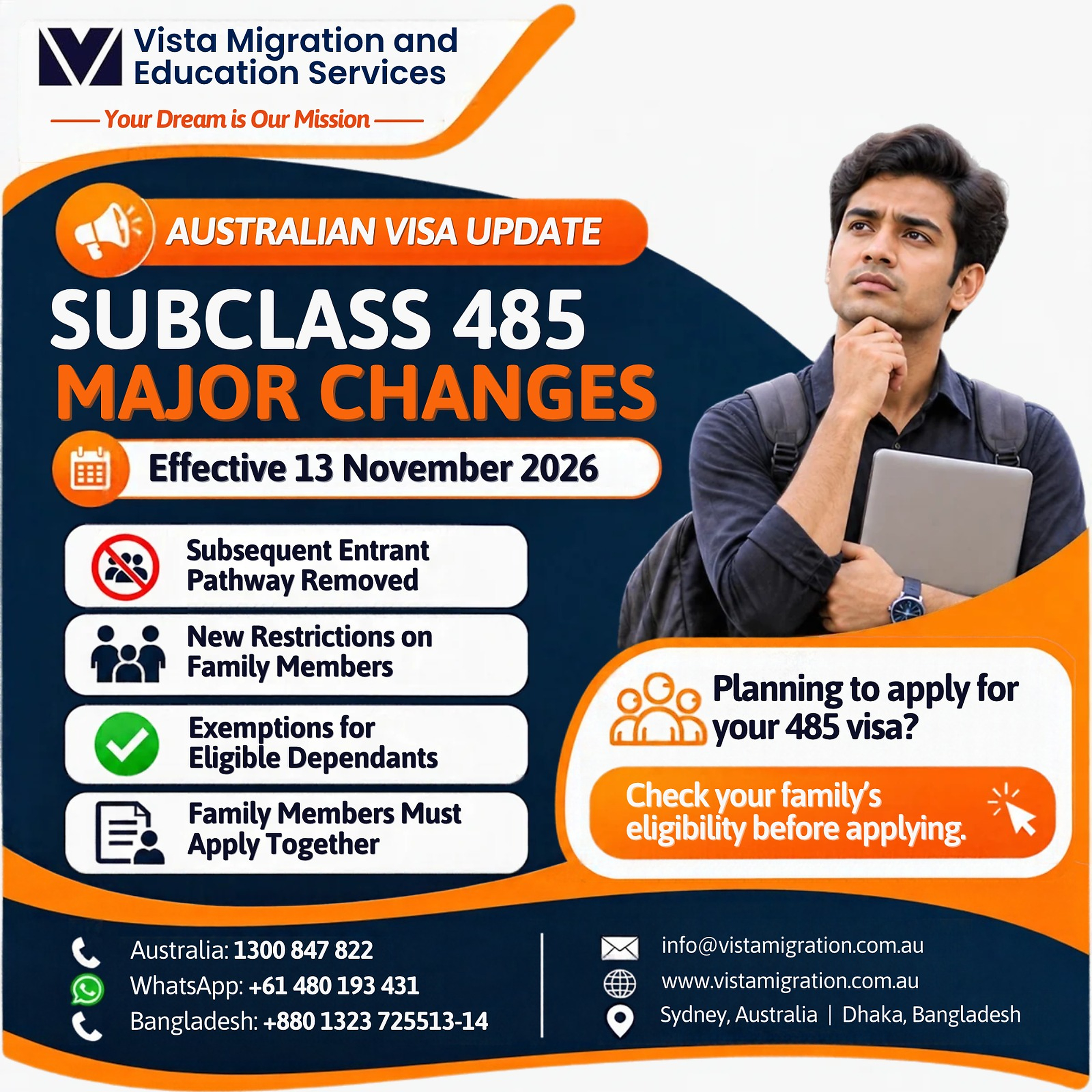
Australia 485 Visa Changes November 2026: Family Rules
Subclass 485 visa changes: new family rules from 13 November 2026
Last updated: 16 November 2026 | IN FORCE
Australia has changed who can join a Temporary Graduate (subclass 485) visa applicant. From 13 November 2026, eligible family member sgenerally must apply with the graduate, and new family members can only be included in defined circumstances. The reform follows the October Student visa family restrictions. [1–2]
What changed on 13 November?
Previously, eligible partners and dependent children could generally apply to join a 485 holder later through a subsequent-entrant application. The new regulations remove that pathway for applications made from 13 November 2026. The change applies to all current 485 streams, including the regional second Post-Higher Education Work stream. It also affects applications by family members of people who already hold a 485 visa. [1–2]
The graduate must lodge in Australia, outside immigration clearance. Eligible secondary applicants may lodge in or outside Australia, but their applications must be combined with the graduate’s application. The November reform does not change the ordinary substantive eligibility requirements for primary applicants, such as the applicable age, qualification,English and study requirements. [1–2]
Who can still be included?
For a first 485 application, an eligible family member can qualify through their history as the graduate’s Student visa dependant if they currently hold that visa, held it on 2 October 2026, or held it within the six months immediately before the application. For a second 485, a family member can qualify if they currently hold, or held within the previous six months, a 485 as the graduate’s dependant. The primary and secondary applicants must have held the earlier visa in the corresponding capacities. [1–2]
The regulations also allow new or existing eligible family members where the primary applicant meets one of the following categories:
· Holds a passport from one of the following 23 countries:
Pacific-regional countries (13): Federated States of Micronesia, Fiji,Kiribati, Nauru, Palau, Papua New Guinea, Republic of the Marshall Islands,Samoa, Solomon Islands, Timor-Leste, Tonga, Tuvalu and Vanuatu.
Other specified ASEAN countries (10): Brunei, Cambodia, Indonesia, Laos,Malaysia, Myanmar, the Philippines, Singapore, Thailand and Vietnam. [5]
· Completed the doctoral degree associated with their most recent Student visa.
· Their most recent Student visa was granted for a course, or courses, each fully funded by a foreign government.
These exceptions permit family inclusion, not separate subsequent-entrant applications. All applicants still need to meet the applicable family-unit, health, character and other visa criteria. A family member who does not qualify cannot make a valid application simply because ImmiAccount allows their details to be entered. [1–2]
What about children born after the previous visa?
A child born after the grant of the graduate’s most recent Student or 485 visa may qualify for inclusion in a combined 485 application. A child born overseas after the graduate has already obtained a 485 cannot later join through a subsequent-entrant 485. Where a non-citizen child is born in Australia to a 485 holder, the child generally acquires the parent’s visa by operation of law; notify Home Affairs. A birth while an application is pending should also be reported promptly because regulation 2.08 may deem the child’s application combined with the parent’s. [1–4]
What happens to earlier applications and existing visas?
Applications lodged before 13 November 2026 continue under the former rules, including valid subsequent-entrant applications already lodged. The amendment does not automatically cancel existing 485 visas or visas already granted to dependants. A new application lodged from 13 November,however, is subject to the new requirements even if the graduate’s visa was granted earlier. [1–2]
Examples: how the changes affect graduates
Example 1 – A Bangladeshi graduate whose spouse held a Student visa as their dependant within the last six months can potentially include the spouse in a combined first 485 application. The ordinary family and other criteria still apply.
Example 2 – A Bangladeshi graduate marries after completing a master’s degree, and the spouse has never held a qualifying dependant visa. A Bangladeshi passport alone does not qualify for the Pacific or ASEAN passport exception. Unless another statutory exception applies, the spouse cannot be included in the graduate’s new 485 application.
Example 3 – A graduate who completed a PhD on their most recent Student visa may include an eligible new spouse who was not previously a dependant. They must lodge together; the spouse cannot apply later as a subsequent entrant.
Example 4 – A graduate already holding a 485 wants to bring a spouse to Australia after 13 November. A new separate 485 subsequent-entrant application is no longer available, even if the graduate meets a family-inclusion exception. Other visa options require separate assessment.
What should graduates do now?
Before applying, confirm the correct stream and application deadline, check every family member’s visa history and passport, and gather relationship and dependant evidence. Consider the timing of any overseas family member’s application. Do not rely on an invalid application for lawful status or bridging-visa arrangements; a finding of invalidity is not a merits-reviewable visa refusal. Seek individual advice if your visa is expiring or your circumstances are changing. [2]
Official sources and legislation
2. Home Affairs — Changes to Temporary Graduate visa family member rules.
3. Migration Regulations 1994 — regulation 2.08 (newborn children).
4. Migration Act 1958 — section 78 (child born in Australia).
5. Home Affairs Legislation Amendment (2026 Measures No. 1) Regulations 2026 — F2026L00874, Schedule 3, items 1 and 43 (country definitions and lists). Official explanatory statement
RMA disclaimer
Disclaimer: This post is for general information only and does not constitute migration, legal, or education advice. Visa requirements and government policies may change. Individual circumstances should be assessed by a MARA Registered Migration Agent before making any migration-related decision. All services are subject to our associated authorities’ and providers’ terms and conditions.
Md Obaydul Huq | Registered Migration Agent (MARN 1804551)
Vista Migration and Education Services
